






.tmedium.png)
Popular Culture in Barcelona
The city that celebrates with its body
What makes Barcelona's festivals different from those of any other European city? What are the castellers — the human tower builders — and why has UNESCO named them Intangible Cultural Heritage of Humanity? What does Sant Jordi actually feel like, lived from the street? And what happens at the Gràcia neighbourhood festival that happens nowhere else on earth?
There is a Barcelona that never appears in museums. It surfaces on the 23rd of April, the 23rd of June, the third weekend of August and the last week of September. It builds human towers ten storeys high to celebrate something no billboard announces. It has lit fires in the squares of the Gothic Quarter since before the Gothic Quarter had a name. That Barcelona is not visited: it is lived. And to live it, you need to know when and where to look.
— Barcelona's festivals are not performances. They are the city speaking in its own language. —
Popular Culture in Barcelona
The city that celebrates with its body
What makes Barcelona's festivals different from those of any other European city? What are the castellers — the human tower builders — and why has UNESCO named them Intangible Cultural Heritage of Humanity? What does Sant Jordi actually feel like, lived from the street? And what happens at the Gràcia neighbourhood festival that happens nowhere else on earth?
There is a Barcelona that never appears in museums. It surfaces on the 23rd of April, the 23rd of June, the third weekend of August and the last week of September. It builds human towers ten storeys high to celebrate something no billboard announces. It has lit fires in the squares of the Gothic Quarter since before the Gothic Quarter had a name. That Barcelona is not visited: it is lived. And to live it, you need to know when and where to look.
— Barcelona's festivals are not performances. They are the city speaking in its own language. —
I. The body as language: castellers, sardanes and gegants
Before dates, you need the grammar.
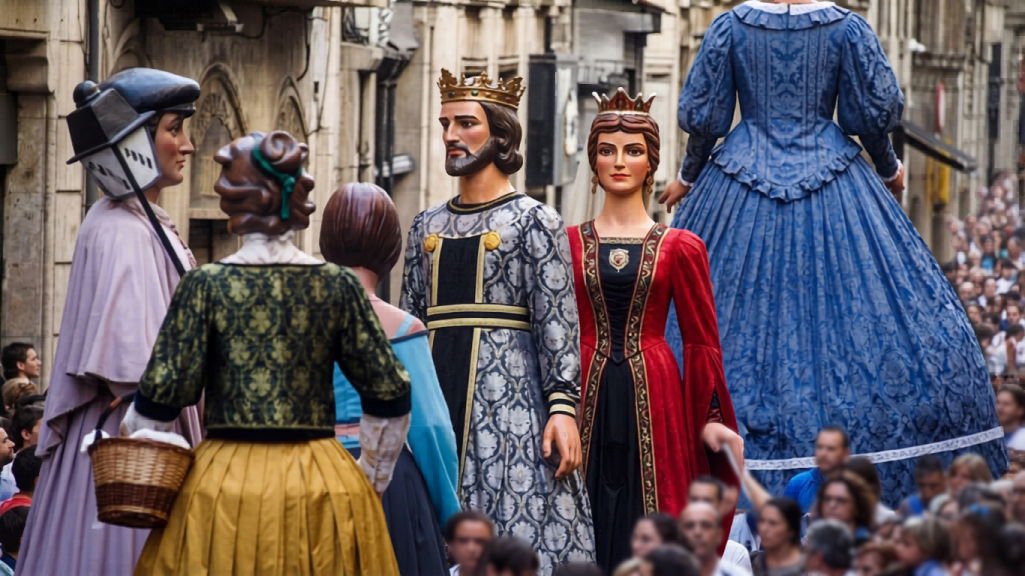
Catalan popular culture has one characteristic that distinguishes it from almost all European festive tradition: the protagonist is not the spectator but the participant. The castellers — the human tower builders — do not perform for an audience; they build with it. The sardana, the traditional circular dance, is not danced for those watching; it is danced in a ring, hand in hand, in public space. The gegants — the giant processional figures — do not parade before the crowd; the crowd walks with them.
The castellers
The most recognised Catalan tradition, and the hardest to explain without having seen it. A colla castellera — a human tower team; they exist throughout Catalonia, but Barcelona has its own — builds human towers between six and ten storeys high. The base is called the pinya: hundreds of people compacted into a circle that absorbs the weight of everything above. Then come the troncs, the dosos, the terç, and at the summit, the pom de dalt — the three or four lightest children in the group. The smallest, the enxaneta, crowns the tower by raising one arm with four fingers extended — the four rays of the senyera, the Catalan flag — before descending through the centre of the structure, wrapped in the arms of those holding it.
UNESCO declared them Intangible Cultural Heritage of Humanity in 2010. Not because they are spectacular — they are — but because they represent a model of social cohesion without parallel: young and old, the strong and the small, all necessary, none dispensable. A colla castellera has no star. It has structure.
The sardana
More discreet, but no less layered. A group of musicians — the cobla — plays in the square. People join, take hands and form a circle that turns with precise, regular steps. Anyone may enter at any moment, opening the circle to make room. There is no hierarchy. No compulsory audience. The circle opens and closes without pause throughout the performance. In the cloister of the Cathedral — twenty metres from Lamaro — sardanes are danced every Sunday. The Cathedral of the Holy Cross and Saint Eulàlia has been the natural stage for this form of being together for centuries.
Els gegants
Giant figures several metres tall — a king, a queen, a historical or legendary character — which each neighbourhood's gegants team carries in procession during the festivals. Each one has its own story. Those of the Barri Gòtic have been in the street since the seventeenth century. They weigh between forty and eighty kilos, carried on the shoulders of a single person who rotates inside the figure, marking the rhythm of the music. To those watching from the street, they dance. For whoever carries them, it is a physical test that lasts for hours.
— A colla castellera has no star. It has structure. That is what makes it unbreakable. —
II. Sant Jordi: the dragon, the rose and the city that dresses itself
The legend predates the festival by centuries.
A Christian knight — Jordi in Catalan, George in English — slays a dragon that has terrorised a city. From the dragon's blood grows a red rose. The knight offers it to the maiden who was to be sacrificed. The maiden, in some versions, is the king's daughter. In others, she is the people entire.
Sant Jordi has been patron of Catalonia since the fifteenth century. The 23rd of April is his feast day because it coincides with the death of Cervantes and Shakespeare — both on 23 April 1616 — and in 1923 the Mancomunitat de Catalunya chose that date to establish the Day of the Book. Over time, the two gestures — the dragon's rose and the book — fused into one. Today, to give a rose is to give the legend. To give a book is to give the city that reads.
But what no text conveys is what happens to the buildings.
On the 23rd of April, Barcelona dresses. The balconies of Passeig de Gràcia, the Gothic Quarter, the Born and the Eixample appear adorned with roses and the senyera — the Catalan flag of four red stripes on a yellow ground. The Modernista façades of the Eixample, the medieval palaces of the Gòtic, the residential buildings of the Born: all carry flowers. This is not institutional decoration. It is every neighbour, every shop, every institution deciding that day that their façade also celebrates.
Casa Batlló, on Passeig de Gràcia, stages the entire legend: its façade — whose surface evokes a dragon's skin, the tower crowned in the shape of a dorsal spine — becomes on the 23rd of April the backdrop for a re-enactment of the story of Sant Jordi. The Cross of Sant Jordi crowns the building. The dragon was already there before the festival arrived.
In the Barri Gòtic, the scent of roses arrives before the light. The stalls appear before dawn in the narrow streets of the neighbourhood — Via Laietana, Carrer del Bisbe, Plaça de Sant Jaume. The contrast between medieval stone and the colour of flowers has a beauty that no filter improves and that no other day of the year repeats.
Sant Jordi is not planned. It is walked.
— From the dragon's blood, a rose. Centuries of the same story. And every 23rd of April, they believe it again. —
III. Fire: Sant Joan and the Correfoc
The night of the 23rd of June is the loudest of the year in Barcelona. Entirely by design.
La Nit de Sant Joan — the eve of Saint John's Day — is the midsummer solstice festival. Technically it is the vigil of the feast of the 24th of June, patron of Catalonia. In practice it is the night Barcelona burns the old year and receives the new with fire, gunpowder and music until dawn.
Catalans are the highest per-capita consumers of fireworks in Europe. Sant Joan is the reason. From ten at night until five in the morning, the entire city sounds as though it is at war. The firecrackers begin days earlier, but the night of the 23rd concentrates everything: bonfires in the neighbourhoods, cava, cocas de Sant Joan — a flat brioche cake with candied fruit and pine nuts, the traditional sweet of the celebration — and the longest firework display of the year from the castle of Montjuïc.
Whoever sleeps in Barcelona that night should know they will not sleep.
The Correfoc
It takes place at neighbourhood festivals and above all at La Mercè in September, but it deserves its own explanation because it is the most singular popular culture experience the city offers. A group of people dressed as devils — the colla de diables, the neighbourhood's devil troupe — moves through the streets with barrows and canisters of fireworks, surrounded by cardboard and wooden dragons spitting fire. The audience does not watch from the pavement: it steps inside. Protected by an anorak, a cloth tied around the head and protective goggles — the unofficial uniform of the Correfoc — participants dance among the sparks, beneath the fire, grazing the dragons. It is loud, warm, physically intense and entirely voluntary.
The diables have their own hierarchy, their own rehearsal calendar, their own costumes. They have been in the neighbourhood for decades. Many started as children and today are the ones who carry the dragon. It is the most direct form of transmission that exists of what it means to belong to a place.
— At the Correfoc there are no seats. The audience is part of the fire. —
IV. The neighbourhood festivals: when the city stays home
The neighbourhood festas majors are the non-tourist heart of Barcelonan popular culture. Each neighbourhood has its own, on different dates, with its own gegants, its own colla de diables, its own reference castellers team and its own programme. They are not designed for anyone from outside. That is exactly what makes them worth attending.
La Festa Major de Gràcia
The second half of August, with its peak around the 15th. The most photographed neighbourhood festival in Europe. For five days, the streets compete against each other for the best decoration. Each street — Verdi, Petritxol, Milà i Fontanals, Torrent de l'Olla — becomes a different stage: arches of recycled plastic bottles, vertical paper gardens, galaxies of light bulbs suspended between balconies, installations that take weeks to build and last five days. Neighbours assemble them. Neighbours dismantle them. The jury that prizes them is made of neighbours. At night the streets fill with performances, sardanes, gegants and the Correfoc de Gràcia, one of the most attended in the city.
La Festa Major de Sants
The last week of August. It has a tradition of street decoration comparable to Gràcia, with one distinction: the streets of Sants are wider, allowing installations of greater scale. Sants has a working-class and industrial identity that shows in the aesthetic of its decorations — more conceptual, more political, less ornamental than those of Gràcia. For anyone wanting to understand Barcelona beyond the Gothic Quarter and the Eixample, Sants in August is necessary reading.
La Festa de la Sagrada Família
The second week of April. One of the few neighbourhood festivals that offers the possibility of seeing the Sagrada Família as the backdrop to a sardana or a castellers performance — an image that no organised visit to the temple can provide.
La Festa Major del Barri Gòtic
June. The fixed elements are the neighbourhood's historic gegants and the Correfoc through the medieval streets of the Gòtic: Via Laietana, Carrer del Bisbe, Plaça de Sant Jaume. Watching a correfoc in streets four metres wide, with sparks grazing the Gothic façades, is an experience that exists nowhere else.
— Neighbourhood festivals are not designed for outsiders. That is precisely what makes them authentic. —
V. La Mercè: the city's great festival
From the 20th to the 24th of September, Barcelona celebrates the Festa Major de la ciutat — the festival of La Mercè, in honour of the Verge de la Mercè, co-patron of the city alongside Santa Eulàlia.
La Mercè is the most concentrated festival in the Barcelona calendar. Over five days, the programme accumulates more than six hundred events across the city's ten districts: concerts in Parc de la Ciutadella and in squares throughout the city, the general Correfoc along Via Laietana, the castells competition, sardanes, gegants, and the year's longest firework display at Parc de la Ciutadella.
The Correfoc General
It runs the length of Via Laietana on the night of the 23rd of September. Twenty-five colles de diables — five hundred people — and a dozen dragons advance from the Port Vell to the Arc de Triomf over two hours. It is the longest and most attended Correfoc in Catalonia. Via Laietana — which borders the Barri Gòtic metres from Lamaro — is the exact route of the procession.
The Concurs de Castells
The human tower competition brings together Catalonia's most important colles castelleres in Plaça de Sant Jaume — two hundred metres from Lamaro — to attempt the most demanding structures in their repertoire. The square full, the silence as the tower rises, the roar when the enxaneta crowns.
The concerts
At Parc de la Ciutadella and the Paral·lel, they bring together international and local artists with programming that in recent editions has included Rosalía, Caetano Veloso, John Cale and Manel, among others.
— La Mercè has no perimeter. It is the entire city turned into a stage for five days. —
VI. Santa Eulàlia: the winter festival
In February, when most European cities are at their greyest, Barcelona celebrates the Festa Major d'Hivern — the festival of Santa Eulàlia, co-patron of the city, whose story lives literally twenty metres from Lamaro.
The Cathedral of the Holy Cross and Saint Eulàlia holds Eulàlia's remains in its crypt, in a fourteenth-century alabaster tomb. In the cloister live thirteen white geese — one for each year of the saint's life, one for each martyrdom she endured before dying at the age of thirteen, in the year 304. White because she died in purity. There is a member of the cathedral chapter whose sole responsibility today is to care for them. The cloister has not changed. Neither have the geese.
On the 12th of February, the city marks its festival with the full programme: gegants through the Barri Gòtic, castellers in the Plaça de la Catedral, sardanes in the cloister, the Correfoc d'Hivern through the medieval streets of the neighbourhood. The particular quality of the Festa de Santa Eulàlia is that it takes place in the city's most historic quarter — the Gòtic, built over the traces of Roman Barcino — and the spaces it uses are the same ones that have hosted these practices for centuries.
For a guest at Lamaro in February, Santa Eulàlia is the reason the month does not feel off-season. It is the smallest of the four great festivals, the most neighbourhood in scale, the most intimate. And the one that happens closest.
— The geese have been there since the Middle Ages. Someone cares for them today. Barcelona knows how to honour what it holds sacred. —
VII. Lamaro and popular culture: the exact position
Avinguda de la Catedral is not just Lamaro's address. It is one of Barcelona's oldest festive axes.
The Correfoc de Santa Eulàlia in February, the gegants procession of the Barri Gòtic in June, the Correfoc General de La Mercè in September: all pass along Via Laietana and Avinguda de la Catedral, or within metres of them. The castellers perform in the Plaça de la Catedral — the square directly in front of Lamaro — during La Mercè and Santa Eulàlia. The sardanes sound in the cloister every Sunday of the year. The festivals do not pass near Lamaro. They pass through here.
Lamaro's rooftop offers during Correfoc nights a perspective that exists at no other point in the neighbourhood: the sparks advancing along Via Laietana seen from above, with the Cathedral behind. It is an image that cannot be planned — only enjoyed from the exact position.
The Cathedral-view rooms offer the same advantage at an intimate scale. The sound of the cobla arrives before the image. The gegants of the Gòtic pass at balcony height. There are festivals that are better lived from within than from the street.
For guests with a direct booking, Lamaro's team provides guidance on which celebrations coincide with the dates of the stay, which position offers the best perspective for each festival and how to participate — not just observe — in those that allow it.
— Some festivals are better lived from within than from the street. At Lamaro, within is Avinguda de la Catedral. —
Calendar: Popular Culture in Barcelona 2026–2027
The most significant events in the Barcelona popular culture calendar for the next twenty-four months:
2027 dates are indicative and subject to official confirmation.
If you already have dates and want to know which festival coincides with your stay, write to us. Lamaro's team prepares a personalised guide for guests with a direct booking — including where to position yourself, how to participate and what to expect from each celebration.
— There is a difference between watching the city celebrate and celebrating with it. —
私たちと一緒に特典付きで予約してください。
-

最安値保証
-

柔軟な条件
-

アーリーチェックイン / レイトチェックアウト
空き状況により) -

無料駐車場
-

ミニバー初回補充無料