.tmedium.png)
Art and Exhibitions in Barcelona
In Barcelona, art is not simply an addition to the city. It is part of its argument.
What makes Barcelona one of Europe's leading centres for contemporary art? Which exhibitions are worth seeing in Barcelona? How do you choose within such a dense offer?
There are cities where art lives in museums. In Barcelona art is also on the wall of a Born market, in the cloister of a Modernista hospital, in the frieze of a building on Via Laietana that most people never look up to see. For centuries the city has been a laboratory where Mediterranean tradition, Catalonia's drive for cultural expression and a creative class fluent in international movements have converged without losing their own accent. The result is an art scene that does not copy Paris or London: it has its own tempo, its own genealogy, its own institutions.
In 2026, with the World Capital of Architecture as context and the MACBA's 30th anniversary as an institutional landmark, Barcelona offers one of the most coherent and ambitious art programmes in its recent history.
I. The genealogy: from Picasso to Tàpies, via Miró
Understanding art in Barcelona requires, first of all, understanding that this city has not merely consumed art: it has produced some of the most influential figures of the twentieth century. Pablo Picasso spent his decisive formative years here — from fourteen to twenty — frequented studios on Carrer Riera de Sant Joan, exhibited for the first time at Els Quatre Gats, and absorbed the tension between Catalan Modernisme and the European avant-gardes that would define his entire subsequent work. The Museu Picasso (Carrer Montcada, 15-23), installed across five medieval palaces, holds the most complete collection of his early work in the world: not the Picasso of book covers, but the one who was still learning to become Picasso.
Joan Miró is a different story: Barcelonan by birth and by vocation, he built an instantly recognisable visual universe with deep roots in the Catalan land and in European Surrealism simultaneously. The Fundació Joan Miró (Parc de Montjuïc, s/n), which opened its doors on 10 June 1975, is one of the great artist's museums in the world: not merely an archive of work, but a space conceived by Josep Lluís Sert as a dialogue between architecture, garden and Mediterranean light. Joan Miró was born in 1893 at number 4, Passatge del Crèdit, a half-covered passage in the Gothic Quarter a few minutes' walk from Lamaro. He lived between Barcelona, Paris and Mallorca, and through the 1960s and early 1970s, while he was planning his Fundació on Montjuïc with Sert, his home in Barcelona was the Hotel Colón, the building that is today Lamaro. The hotel keeps, in the Sala Miró, one of its event spaces, an engraved plaque reproducing one of his drawings with the dedication "amb tota simpatia" and the date 6 October 1960.
Antoni Tàpies closed the cycle of Barcelona's great twentieth-century masters with a radically different body of work: material, philosophical, shaped in equal measure by Francoist repression and the Zen tradition. His Fundació Antoni Tàpies (Carrer d'Aragó, 255), housed in the Eixample's Casa Montaner i Simon — a Domènech i Montaner Modernista building restored with the artist's own involvement — is one of the most singular spaces in the city: intimate, demanding, making no concessions to mass tourism.
Three artists, three museums, three ways of understanding what art can do with the place where it was born.
-- Picasso learned to draw in Barcelona. Miró learned to dream. Tàpies learned to resist. --
II. The MNAC and Romanesque art: the world's largest collection
Before speaking of contemporary art, it is worth starting at the beginning. The Museu Nacional d'Art de Catalunya (Palau Nacional, Parc de Montjuïc) holds the largest and best-preserved collection of Romanesque art in the world. This is not tourist-guide hyperbole: it is an uncontested museographic fact. In the early twentieth century, a team of Catalan conservators took the extraordinary decision to literally detach mural paintings from dozens of Pyrenean churches that were deteriorating or being plundered by international collectors, and reinstall them in the Palau Nacional with an exact recreation of the original architectural space. The result is entire rooms of eleventh- and twelfth-century Romanesque apses reconstructed stone by stone, their paintings in the same position and under the same light for which they were conceived. It is one of the most singular experiences any museum in Europe can offer.
To that, add the Gothic collection, the complete Catalan Modernisme — Casas, Rusiñol, the entire generation — Renaissance and Baroque art, and a collection of historical photography that few institutions in the world can match. The MNAC is, in sum, the complete visual narrative of a thousand years of Catalan culture.
In 2026 it enters its final season of temporary exhibitions until 2030: expansion works integrating the Palau Victòria Eugènia will add 14,000 new square metres and require the progressive closure of galleries. Before that silence, the museum already showed one of its most significant chapters: Recovered from the Enemy documented works seized by the Franco regime and held by the museum for decades — a chapter rarely told with such clarity.
-- The MNAC closes to rebuild itself. A project that, if it works, will change how the history of art in Catalonia is told. --
III. The MACBA and the Raval: when art transforms a neighbourhood
In 1995, the opening of the MACBA (Plaça dels Àngels, 1) was far more than an institutional launch. Richard Meier's building — white, emphatic, with an interior ramp that organises the visit as an architectural promenade — landed in one of the most densely populated and deteriorated neighbourhoods of the historic centre. The wager was explicit: contemporary art as a catalyst for urban regeneration.
Thirty years on, the balance is honest. The Raval has not been gentrified in the conventional sense — it remains multicultural and lived-in, with all the friction that implies — but it has gained a layer of cultural life that distinguishes it from any other neighbourhood in the city. The MACBA, the CCCB (Carrer Montalegre, 5), the Filmoteca: together they form an ecosystem where art and daily life share the same block.
In 2026, with the thirtieth anniversary as a guiding thread, the MACBA structures its programming around Like a Murmuration of Starlings — a critical rereading of three decades of its collection, on view until September 2026. It is the question the museum asks itself after thirty years: what remains, and why.
IV. The Fundació Joan Miró in 2026: architecture as axis
In the context of the World Capital of Architecture, the Fundació Joan Miró (Parc de Montjuïc, s/n) has structured its entire 2026 programme around a single conceptual axis: architecture as a system of power, control and life.
The most anticipated exhibition of the season is dedicated to Kapwani Kiwanga, winner of the 2025 Joan Miró Prize, on view from 29 April through 13 September 2026. The artist investigates the invisible systems of power that structure built space: lighting designed to surveil, materials that condition behaviour, geometries that include and exclude. In autumn comes Charlotte Perriand — the first major retrospective dedicated to this key figure of modern design in Spain, collaborator of Le Corbusier and Sert, pioneer of a synthesis between art, design and ways of inhabiting. The new permanent collection presentation, inaugurated in March, reorganises Miró's works not by historical or formal criteria but by following the artist's own working processes: the same rooms by Sert, a completely different reading.
V. The Museu Picasso and the Born: five medieval palaces
The Museu Picasso (Carrer Montcada, 15-23) is one of the most visited museums in Spain and, simultaneously, one of the least understood by those who arrive expecting the canonical icons. The museum's strength lies precisely in what cannot be seen anywhere else: the early work, the sketchbooks, the experiments of an adolescent who did not yet know he would change the art of the twentieth century.
The surroundings are inseparable from the experience. Carrer Montcada is one of the densest stretches of medieval civic architecture in all of Europe: five fifteenth-century palaces that the museum has connected with walkways and interior courtyards. Standing in the courtyard of the Palau del Baró de Castellet while the Born hums outside is an experience that has little in common with what is usually meant by "going to a museum".
VI. The galleries and the living scene
Beyond the institutions, Barcelona has a dense and active private gallery scene, shaped in large part by Art Barcelona (ABE) — the association that brings together the city's leading galleries and organises the Barcelona Gallery Weekend, the event that every September marks the start of the artistic season. What follows is a selection of its members, not a complete map.
Mayoral (Passeig de Gràcia, 120) is the reference point for the secondary market in twentieth-century modern art. Carles Taché (Carrer de Consell de Cent, 290) and ProjecteSD (Carrer de Provença, 249) have been working conceptual art with international reach for decades. ADN Galería (Carrer Enric Granados, 49), Àngels Barcelona (Carrer dels Àngels, 16) and Bombon Projects (Carrer del Parlament, 37) represent the generation that has placed Barcelona on the European emerging circuit. La Capella (Carrer de l'Hospital, 56), housed in the chapel of the former Hospital de la Santa Creu, programmes young art with genuine criteria and no admission fee.
Each September, most of these galleries open their new exhibitions simultaneously during the Barcelona Gallery Weekend — four days in which the scene becomes visible to collectors, institutions and international visitors. It is the best moment of the year to take the real pulse of what is happening in Barcelona.
Swab (Recinte Modernista de Sant Pau, C/ Sant Antoni Maria Claret, 167), in October, is the best-positioned emerging art fair among young European and Ibero-American galleries.
-- Galleries are the real thermometer of a scene. In Barcelona, the thermometer has been reading well for decades. --
VII. Lamaro and art: the starting point
The Museu Picasso is eight minutes on foot from Lamaro. The MACBA and CCCB, twelve minutes walking through the Gothic Quarter. The Fundació Antoni Tàpies, twenty minutes. The MNAC and the Fundació Joan Miró, fourteen minutes by taxi from the Cathedral.
Lamaro also has a history of its own with art. Miró was born a few minutes from here and, while he was planning his Fundació on Montjuïc with Sert, the then Hotel Colón was his home in Barcelona. Two minutes away, in Plaça Nova, are the friezes Picasso drew for the headquarters of the Col·legi d'Arquitectes, engraved into the concrete by the Norwegian artist Carl Nesjar. Five minutes away is the Mercat de Santa Caterina, with its colourful ceramic roof by Enric Miralles and Benedetta Tagliabue, visible from some of the Premium Suite balconies.
For guests who book directly, Lamaro's team advises and, when needed, arranges tickets for seasonal exhibitions. Some shows — particularly at the Fundació Joan Miró and the Museu Picasso — sell out on weekends during high season. Ask the team before you arrive.
-- Picasso in Plaça Nova, Miralles at Santa Caterina and Miró in the hotel's guest book. --
Cultural calendar: upcoming events and current exhibitions
Event or experience | Venue and address | Dates and times | Official information |
|---|---|---|---|
A force from the past | CaixaForum · Av. Francesc Ferrer i Guàrdia, 6–8 | 23 September 2026 – 10 January 2027 | |
Anselm Kiefer | La Pedrera · Provença, 261 | 2 October 2026 – 24 January 2027 | |
Charlotte Perriand. The freedom to rethink the world | Fundació Joan Miró · Parc de Montjuïc | 9 October 2026 – 28 February 2027 | |
Gaudí–Miró–Gomis: Deconstructed | Casa Batlló Contemporary · Passeig de Gràcia, 43 | 8 July 2026 – 10 January 2027 | |
Aurèlia Muñoz. Entes | MACBA · Plaça dels Àngels, 1 | 5 November 2026 – 29 March 2027 | |
Jujol, by Perejaume | MNAC · Palau Nacional, Montjuïc | 26 November 2026 – 29 March 2027 | |
Joan Miró Collection | Fundació Joan Miró · Parc de Montjuïc | Permanent |
Check the official programme and admission conditions before your visit. Some activities require a reservation or invitation and are subject to availability.
Lamaro as your starting point: distances to the main museums
Estimated times at normal walking pace (5 km/h). Taxi with normal urban traffic.
Book with us with benefits
-

Best price guaranteed
-

Cancellation insurance included in non-refundable rates.
-

Early check-in / Late check-out
(subject to availability) -

Free parking
-

Complimentary first minibar refill
Your starting point for Barcelona's most creative side
- With terrace or balcony
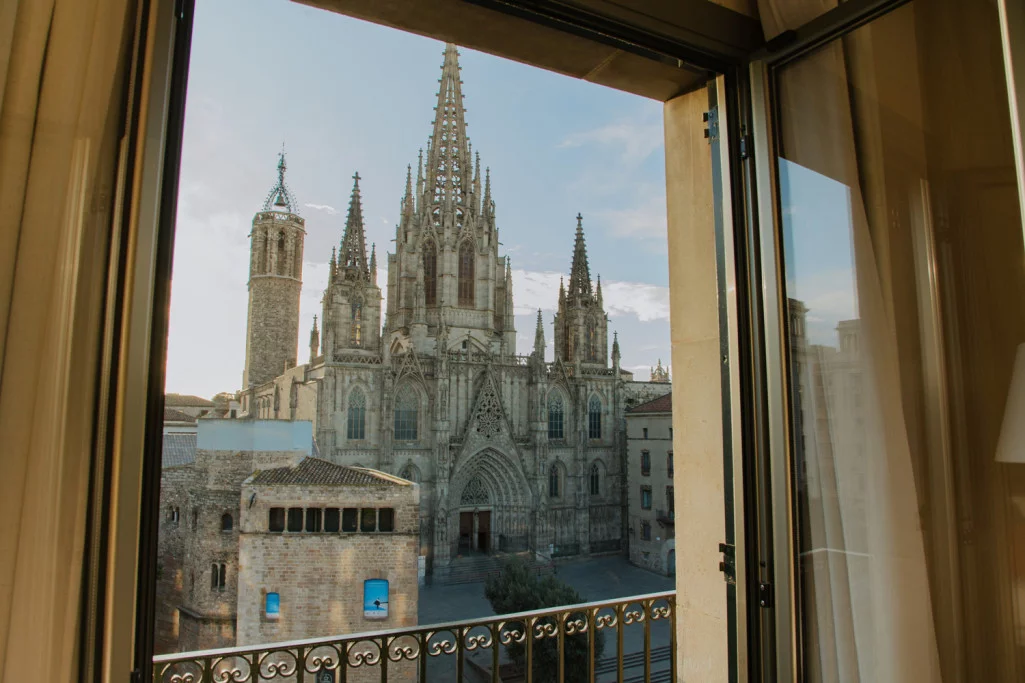
- Views of the cathedral
- Suites
- Triples and Family (Quad)
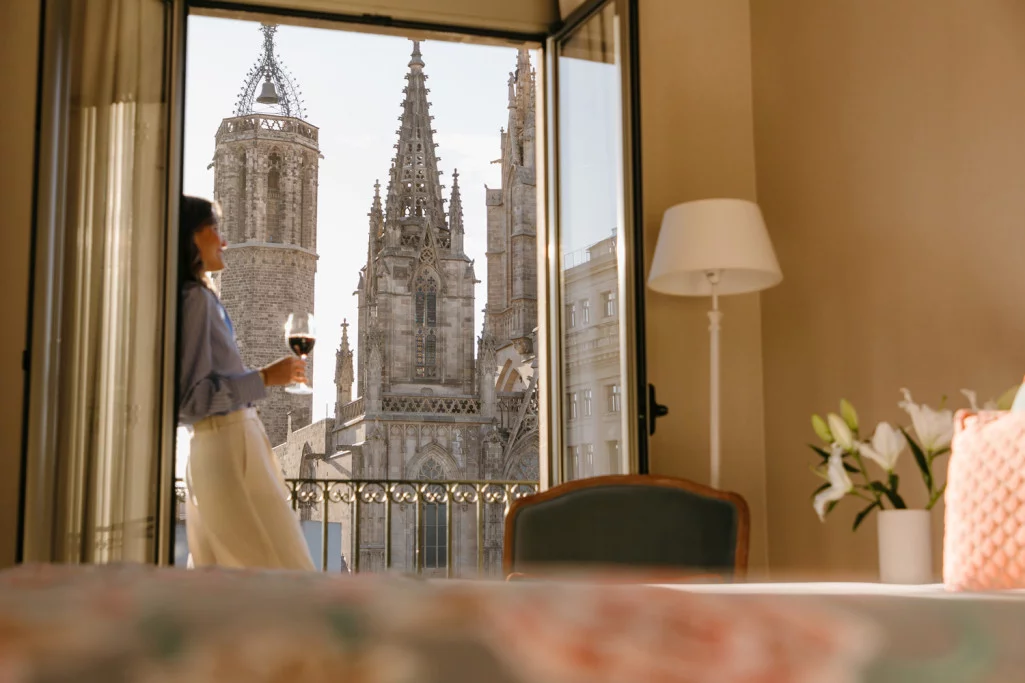

Premium Suite
1 or 2 guests · views · balcony
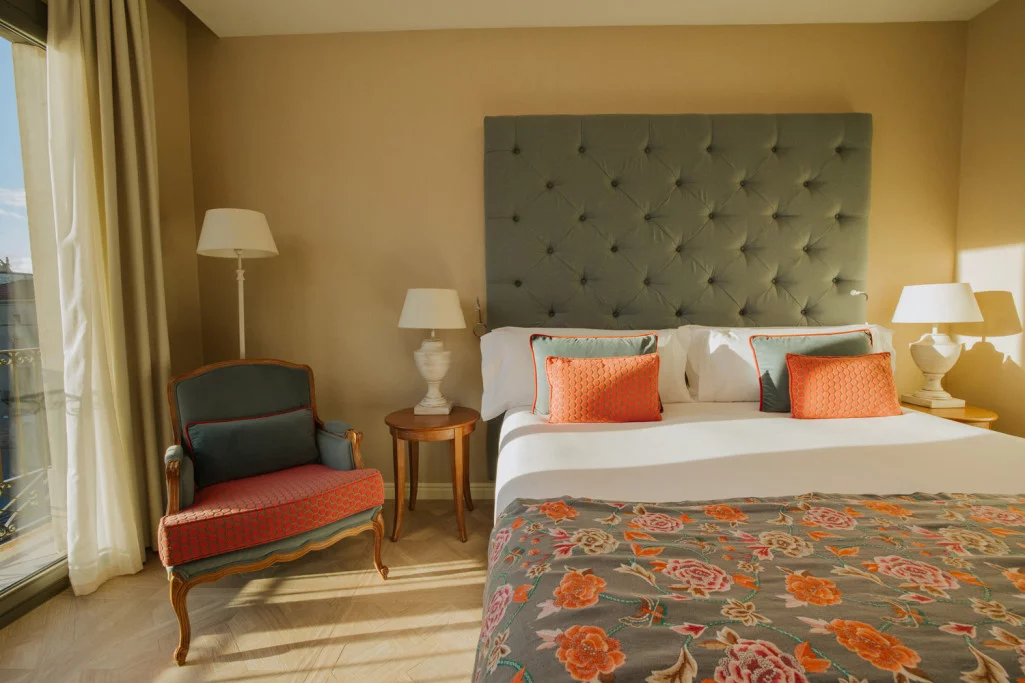
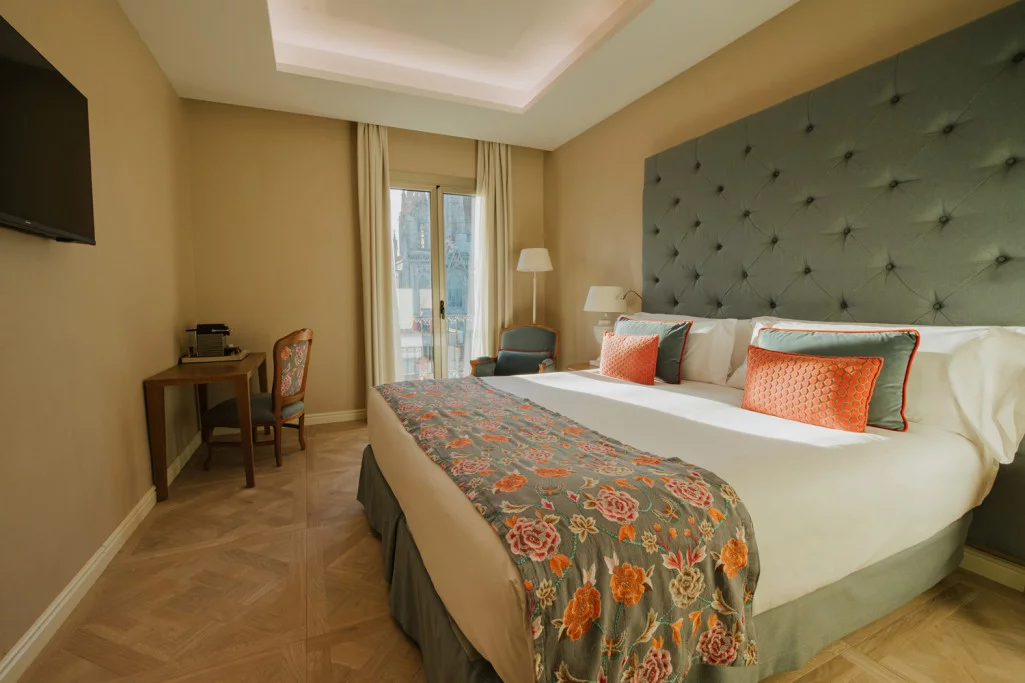
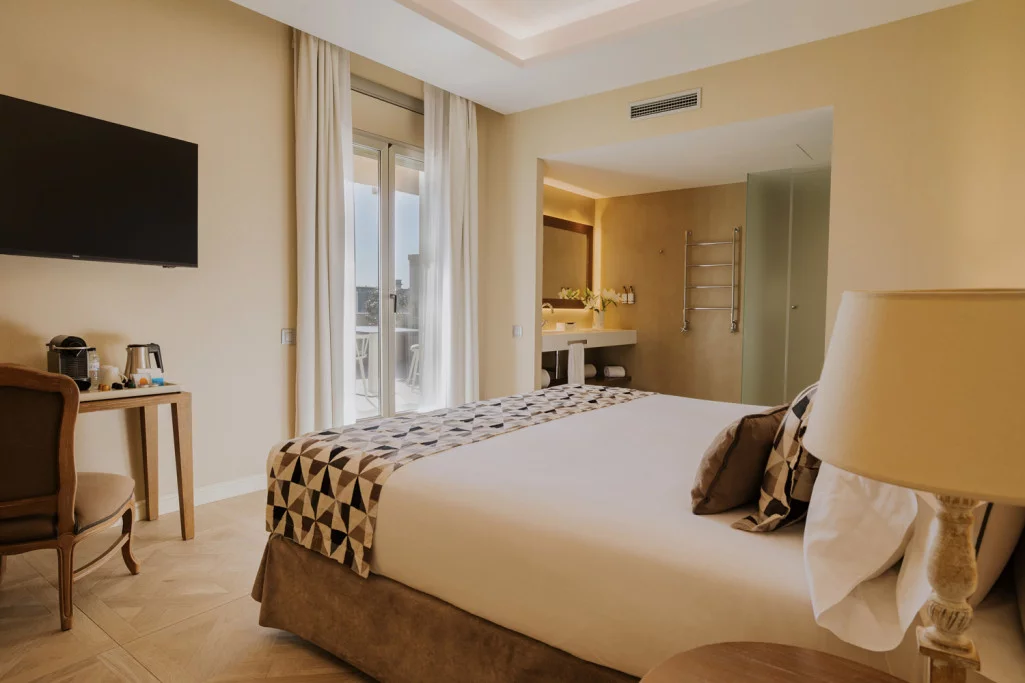
Wake up with Barcelona Cathedral before your eyes. This 25 m² room for one or two guests has a private balcony overlooking one of the city’s most recognisable landmarks. Cathedral views are guaranteed in this room category.
Inside, a rainfall shower, coffee maker and welcoming atmosphere make it a comfortable place to return to after exploring the Gothic Quarter. Step onto the balcony and take a moment to enjoy the city from your own vantage point.
When you book directly with Lamaro, the Design & Craft Tour is included as a complimentary experience. Explore the tour.
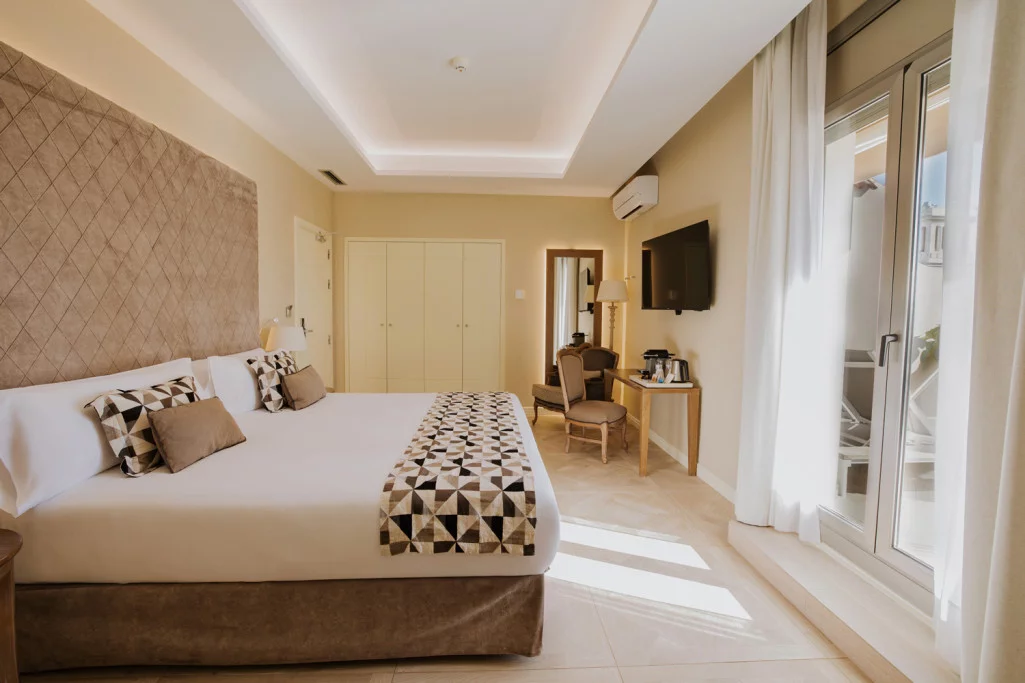
Skyline Suite
1 or 2 guests · terrace
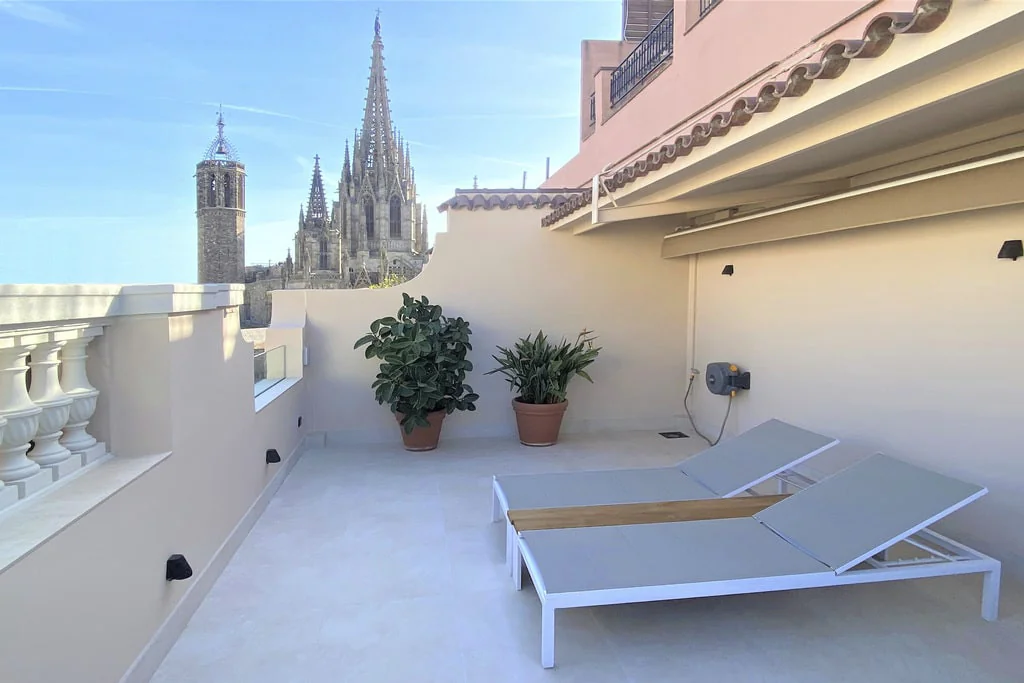
The Skyline Suite is on the hotel’s sixth floor and has a private terrace with a solarium area for 1 or 2 guests. It pairs a comfortable interior with its own outdoor space to enjoy Barcelona in the open air. Interior size (20–33 m²) and terrace size (26–70 m²) vary by room. The views are of the city and vary with each room’s orientation.
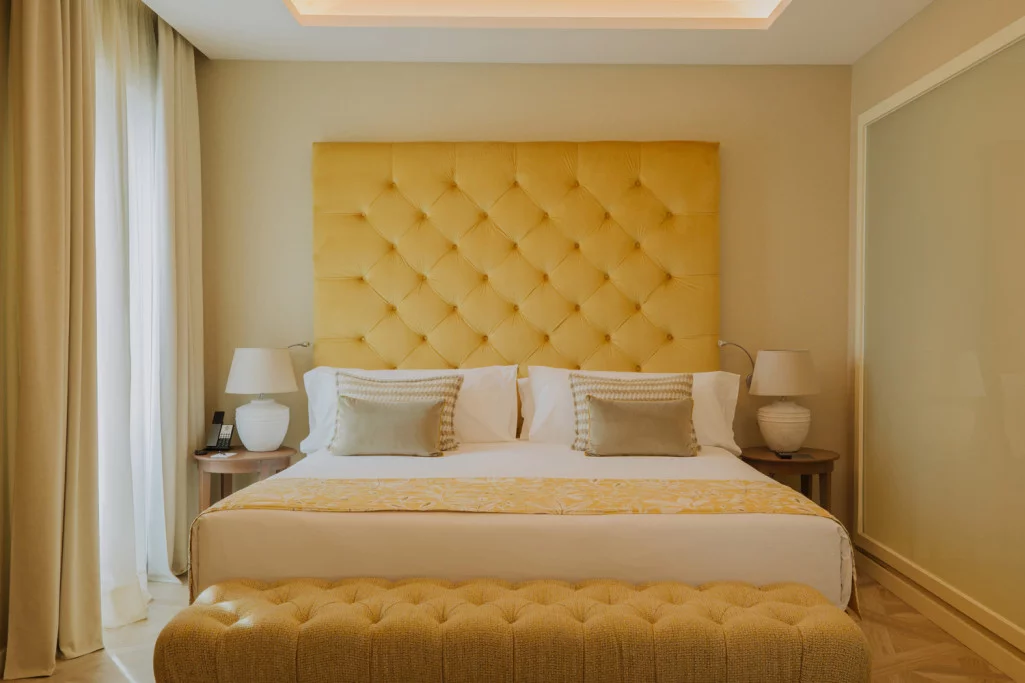
Grand Master Suite
2 adults + 2 children · views · 4 balconies
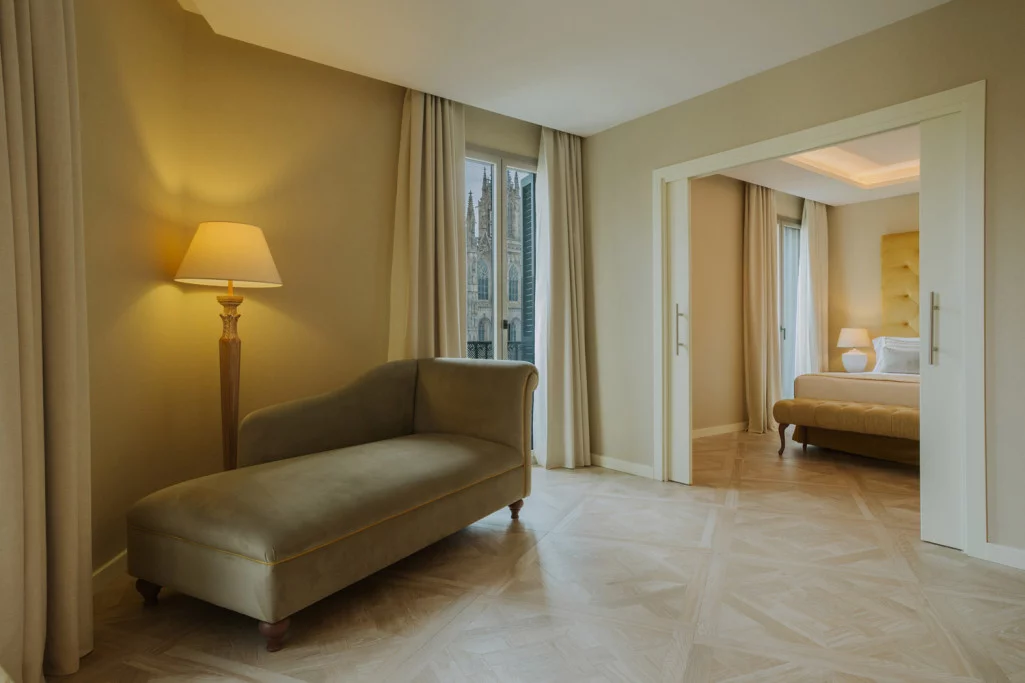
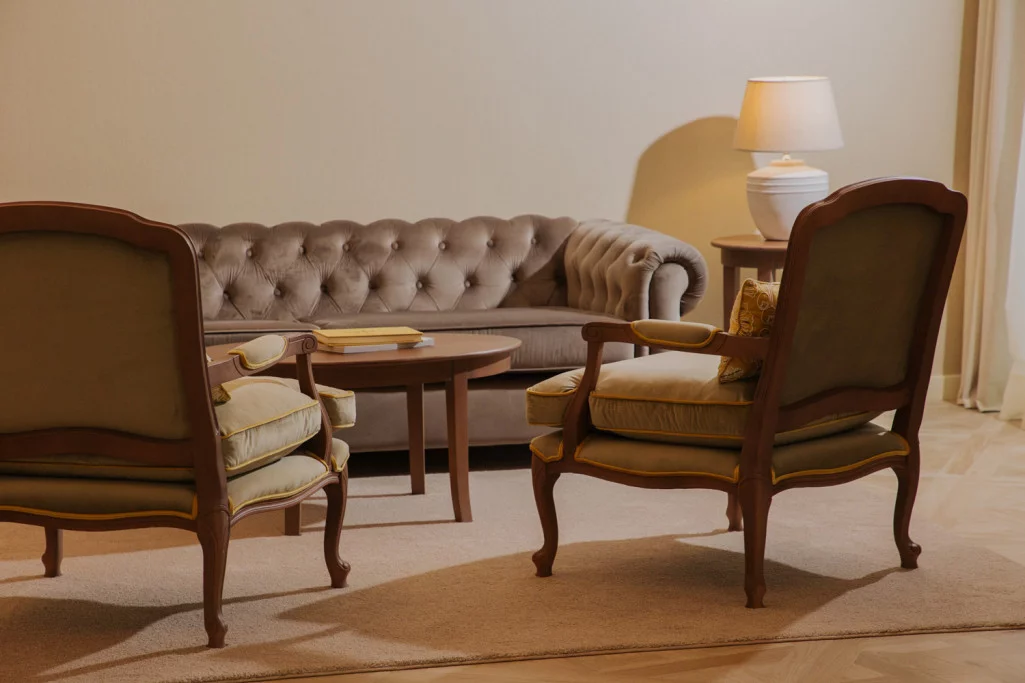
The Grand Master Suite offers 72 m² of space to make yourself at home in Barcelona. Its living room provides a place to spend time together and unwind; the bedroom has a King Size bed, while the bathroom features both a shower and a bathtub. The suite accommodates up to two adults and two children aged 17 or under, making it a comfortable choice for a family stay.
Its four balconies open the suite to the historic centre. Two overlook Barcelona Cathedral, bringing the city into view throughout the day.
When you book directly with Lamaro, the Design & Craft Tour is included as a complimentary experience. Explore the tour.