


.tmedium.png)
Performing Arts in Barcelona
Opera, dance, theatre and flamenco in Barcelona — the most plural scene in southern Europe
Why is Barcelona one of Europe's great capitals of opera and the performing arts?
Where to see opera, dance, theatre and flamenco in 2026?
Some cities build their performing arts scene around a single building. In Paris, the Opéra Bastille and the Palais Garnier set the calendar. In Milan, La Scala defines the season. In Barcelona, no single theatre holds that exclusive weight. The Gran Teatre del Liceu, the Teatre Nacional de Catalunya, the Mercat de les Flors, the Teatre Lliure, the Palau de la Música, the Festival Grec: each institution has its own lineage, its own audience and its own understanding of what it means to take the stage. The result is not fragmentation. It is genuine plurality.
That plurality has deep historical roots. Barcelona was the first city in the Iberian Peninsula to have a permanent opera house — the Liceu, since 1847 — but it was also the city where Catalan-language theatre survived decades of prohibition, and where contemporary dance found a dedicated home at the Mercat de les Flors long before cities of comparable size elsewhere in Europe. It is also the city where flamenco, brought by the great migrations of the twentieth century, took lasting root and today shares stages and festivals with urban dance, contemporary circus and performance art.
In 2026, the year Barcelona holds the title of World Capital of Architecture, the performing arts scene has its own moment of exceptional density: the Liceu closes the Josep Pons era after fourteen years as musical director and opens a five-year Wagnerian cycle; the Festival Grec celebrates its fiftieth edition; the Mercat de les Flors marks twenty years devoted entirely to dance. This is not an ordinary year.
— Barcelona has no single temple of the stage. It has an entire city that performs. —
Performing Arts in Barcelona
Opera, dance, theatre and flamenco in Barcelona — the most plural scene in southern Europe
Why is Barcelona one of Europe's great capitals of opera and the performing arts?
Where to see opera, dance, theatre and flamenco in 2026?
Some cities build their performing arts scene around a single building. In Paris, the Opéra Bastille and the Palais Garnier set the calendar. In Milan, La Scala defines the season. In Barcelona, no single theatre holds that exclusive weight. The Gran Teatre del Liceu, the Teatre Nacional de Catalunya, the Mercat de les Flors, the Teatre Lliure, the Palau de la Música, the Festival Grec: each institution has its own lineage, its own audience and its own understanding of what it means to take the stage. The result is not fragmentation. It is genuine plurality.
That plurality has deep historical roots. Barcelona was the first city in the Iberian Peninsula to have a permanent opera house — the Liceu, since 1847 — but it was also the city where Catalan-language theatre survived decades of prohibition, and where contemporary dance found a dedicated home at the Mercat de les Flors long before cities of comparable size elsewhere in Europe. It is also the city where flamenco, brought by the great migrations of the twentieth century, took lasting root and today shares stages and festivals with urban dance, contemporary circus and performance art.
In 2026, the year Barcelona holds the title of World Capital of Architecture, the performing arts scene has its own moment of exceptional density: the Liceu closes the Josep Pons era after fourteen years as musical director and opens a five-year Wagnerian cycle; the Festival Grec celebrates its fiftieth edition; the Mercat de les Flors marks twenty years devoted entirely to dance. This is not an ordinary year.
— Barcelona has no single temple of the stage. It has an entire city that performs. —
I. The Liceu: the city that rebuilt its opera house
The Gran Teatre del Liceu is not only the oldest active opera house in the Iberian Peninsula. It is the only major theatre in the world to have been destroyed and rebuilt by the same city that founded it — twice.
It was first founded in 1847, driven by the Catalan industrial bourgeoisie as a gesture of cultural and European ambition. The first fire, in 1861, was followed by immediate reconstruction. The anarchist bombing of 1893 — twenty dead in the stalls during a performance of William Tell — barely interrupted the programme. The second great destruction, the 1994 fire that gutted the main auditorium entirely, triggered what contemporary chronicles described as a collective act of mourning. Within days, thousands of people donated money toward the rebuilding. The Liceu that reopened in 1999 was not a restoration. It was a declaration of identity.
Today the Liceu programmes around 110 performances per season — opera, dance, recitals, concerts — and has established a balance between canonical repertoire and contemporary creation that few European opera houses sustain with comparable coherence. The 2025-2026 season, the last under the musical direction of Josep Pons, includes Wagner's Tristan und Isolde, Puccini's Manon Lescaut, Mozart's Le nozze di Figaro and Verdi's Falstaff, with voices of international first rank: Lise Davidsen, Asmik Grigorian, Xabier Anduaga, Juan Diego Flórez. From the 2026-2027 season, Jonathan Nott takes the podium and launches a historic Wagnerian cycle: the four operas of the Ring of the Nibelung, one per season through 2030, in co-production with the Bayerische Staatsoper in Munich.
The Liceu's dance programme deserves attention in its own right. Each season it hosts international ballet companies of the first rank — the Bayerisches Staatsballett brought Giselle in 2025, the Hamburg Ballet under John Neumeier brought Nijinsky in 2026 — alongside gala performances with stars of classical ballet and new creation. The Liceu is not only an opera house. It is the stage where every performing discipline coexists without a fixed hierarchy.
— The Liceu that reopened in 1999 was not a restoration. It was a declaration of identity. —
II. The Palau de la Música: where the architecture is the music
The Palau de la Música Catalana is the only concert hall in the world designated a UNESCO World Heritage Site. Built between 1905 and 1908 by Lluís Domènech i Montaner as the home of the Orfeó Català choral society, it was conceived as a manifesto of Catalan Modernisme: its interior is an explosion of stained glass, mosaic and sculpture that turns every performance into an experience that goes well beyond the auditory. The central skylight, which in winter afternoons fills the stalls with diffuse, coloured light, is difficult to describe in words.
In recent years, the Palau has become one of Barcelona's foremost venues for flamenco. The Gran Gala Flamenco cycle regularly programmes performances by artists of the highest level: the experience of watching flamenco in that Modernista interior — where the architecture is built from the same tensions as flamenco itself, between structure and overflowing emotion — has few parallels anywhere. The Palau also hosts the Barcelona Jazz Festival, Guitar BCN and the Festival Mil·lenni, as well as major recitals from the Liceu's lyric cycle.
There is something the Palau offers that the Liceu cannot replicate: arriving without a plan and finding that the architecture has already given you something before the music begins. The Liceu demands anticipation — major productions sell out weeks in advance. The Palau, by contrast, has programming almost every night of the year and tickets generally available with less lead time. These are two distinct experiences, and Barcelona has the rare fortune of having both.
— The Palau de la Música is the only concert hall that is a UNESCO World Heritage Site. Before a note is played, it is already an architectural experience. —
III. The TNC and the Teatre Lliure: theatre as a cultural act
The Teatre Nacional de Catalunya, inaugurated in 1996 in a building by Ricardo Bofill near the Plaça de les Glòries, is Catalonia's principal public theatre institution. Its stated mission is to preserve and project Catalan language and culture through the performing arts, while remaining open to international contemporary theatre and dance. In a city where Catalan-language theatre was prohibited for decades, the TNC carries the specific weight of an institution that does not only produce performances: it produces cultural continuity.
Under the artistic direction of Carme Portaceli, the TNC has developed a model combining large-scale in-house productions, co-productions with leading European companies and a firm commitment to new Catalan dramatic writing. The 2025-2026 season, under the title «Apropiar-se del relat» (Taking ownership of the story), opened with La mort i la primavera by Mercè Rodoreda, adapted for dance by Marcos Morau and La Veronal — which also premiered at the Venice Biennale — and has included Giovanni's Room by James Baldwin in a version by Eline Arbo, artistic director of the Internationaal Theater Amsterdam.
The Teatre Lliure, founded in 1976 at the height of the democratic transition as an independent theatre with a committed artistic identity, has occupied the Palau de l'Agricultura on Montjuïc since 2001, alongside the Mercat de les Flors and the Teatre Grec. It has two venues — Montjuïc and Gràcia — and a sensibility of its own, closer to aesthetic risk and formal experimentation. It is the stage where Barcelona most frequently encounters what is happening at the edge of European theatre. For current programming: tnc.cat and teatrelliure.com.
— At the TNC, theatre in Catalan is not a tradition being preserved. It is a language that keeps creating. —
IV. The Festival Grec: Montjuïc as a stage
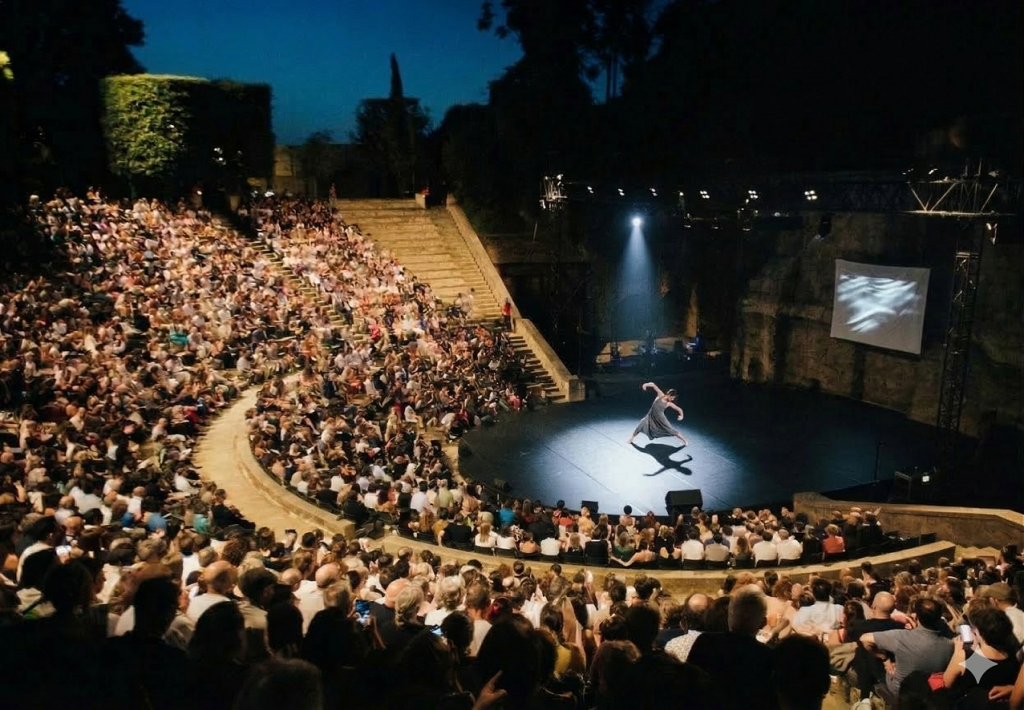
The Teatre Grec was built in 1929 for the International Exhibition, inspired by the theatre of Epidaurus, on the hillside of Montjuïc. An open-air stone amphitheatre with capacity for two thousand, surrounded by cypress trees, with views over the city and the Mediterranean beyond. For decades it lay largely unused. In 1976, as the dictatorship was beginning to unravel and the city was recovering its own voice, a group of actors and directors organised a summer theatre season in that space. The Festival Grec was born.
Fifty years on, the Grec is the most important performing arts festival of the Barcelona summer and one of the most significant on the European calendar. It runs from 29 June to 31 July 2026 — its fiftieth edition — across 39 venues including the Teatre Grec itself, the Mercat de les Flors, the Teatre Lliure, the MACBA, the Museu Picasso and unconventional spaces in every neighbourhood. The programme combines theatre, dance, circus, music and hybrid forms, with local, national and international artists. It is the moment of the year when Barcelona's performing scene becomes most visible to those arriving from outside.
The Teatre Grec remains the symbolic heart of the festival. Watching theatre or dance in that stone amphitheatre, on a warm July night, with the scent of cypresses and the city spread below, is one of the experiences Barcelona offers that has no equivalent in any other venue.
— The Teatre Grec was built for an exhibition and has spent fifty years as the heart of Barcelona's summer performing arts scene. —
V. The Mercat de les Flors: dance has a home
The Mercat de les Flors occupies a Noucentisme pavilion built for the 1929 International Exhibition and converted into a municipal theatre in 1985, when Peter Brook inaugurated it with his legendary production of the Mahabharata. Since 2007 it has been Barcelona's Centre for the Arts of Movement: a space devoted exclusively to dance, performance and the arts of the body in all their diversity. Three auditoria — the Sala Pina Bausch, the Sala Maria Aurèlia Capmany and the Sala Ovidi Montllor — and a programme that mixes European repertory companies with emerging local artists, contemporary dance with circus and performance.
In the 2025-2026 season, the Mercat marks twenty years as a structure devoted entirely to dance, with an unusually strong presence of large-format productions: the Ballet de Lorraine under Maud Le Pladec, the Dresden Frankfurt Dance Company, the Danish Dance Theatre directed by Valencian choreographer Marina Mascarell with Bloody Moon and the restaging of Mongrel. The Dansa Metropolitana festival — which every March fills twelve cities of the metropolitan area with 177 performances of 90 works — is based at the Mercat.
The Mercat is also the place where Barcelona has its most honest conversation with flamenco. Not flamenco as a tourist product, but flamenco as a language in evolution. The Mercat regularly programmes artists working at the border between contemporary dance and flamenco — Rocío Molina, Leonor Leal, Sol Picó, whose fusion of classical ballet and flamenco defines a distinctly Barcelonan lineage — with the same curatorial rigour it applies to the great European companies. Barcelona is not a flamenco city by origin. But it is one of the cities where flamenco has evolved furthest beyond Andalusia. The Mercat is the main reason.
— Barcelona's relationship with flamenco is not one of origin. It is one of discernment. —
VI. Lamaro and the scene: the starting point
For guests with a direct booking, the Lamaro team knows the season's programme with genuine curatorial perspective — not just what is on, but what is worth attending, depending on the moment and the interests of each guest. Some Liceu productions sell out weeks in advance; others have tickets available the day before. The Festival Grec, open-air in July, is generally more accessible. Knowing when to act is part of the service.
Barcelona has the most plural performing arts scene in southern Europe. The Gran Teatre del Liceu — the oldest active opera house in the Iberian Peninsula — stands two minutes on foot from the Palau de la Música Catalana, the only concert hall in the world designated a UNESCO World Heritage Site. Both are part of the same historic fabric of the Gothic Quarter where Lamaro Hotel is located, making a stay here the natural starting point for any guest with a passion for opera, dance or theatre. No other hotel in Barcelona holds this position.
— The most plural performing arts scene in southern Europe. And the best seat in the house is in the Gothic Quarter. —
Programme: Performing Arts in Barcelona 2026–2027
Named performances with a story worth telling, listed in date order. Always confirm exact times and availability on each institution's website before your visit.
* Indicative dates — confirm on the institution's website. ** The Liceu 2026-2027 season and Grec 2027 programme are announced in June 2026 and spring 2027 respectively.
Lamaro as a starting point: distances to the main performing arts venues
Estimated times at normal walking pace (5 km/h). Metro from Jaume I or Urquinaona. Taxi under normal urban traffic conditions.
Book with us with benefits
-

Best price guaranteed
-

Cancellation insurance included in non-refundable rates.
-

Early check-in / Late check-out
(subject to availability) -

Free parking
-

Complimentary first minibar refill
Your starting point for Barcelona's theatre and dance scene
- With terrace or balcony
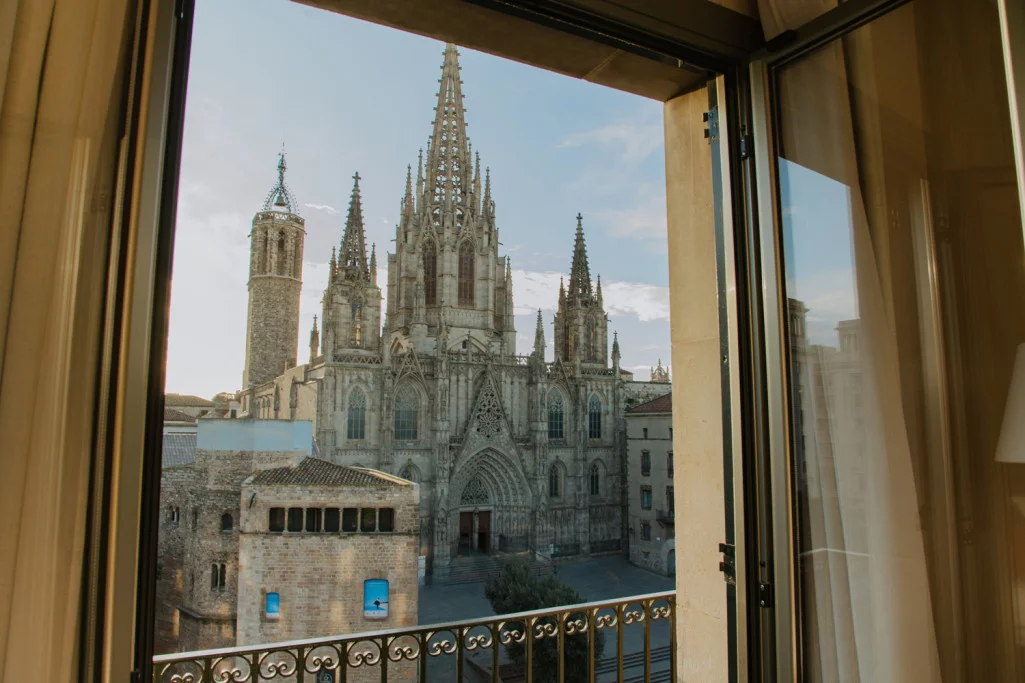
- Views of the cathedral
- Suites
- Triples and Family (Quad)

Premium Suite
1 or 2 guests · views · balcony
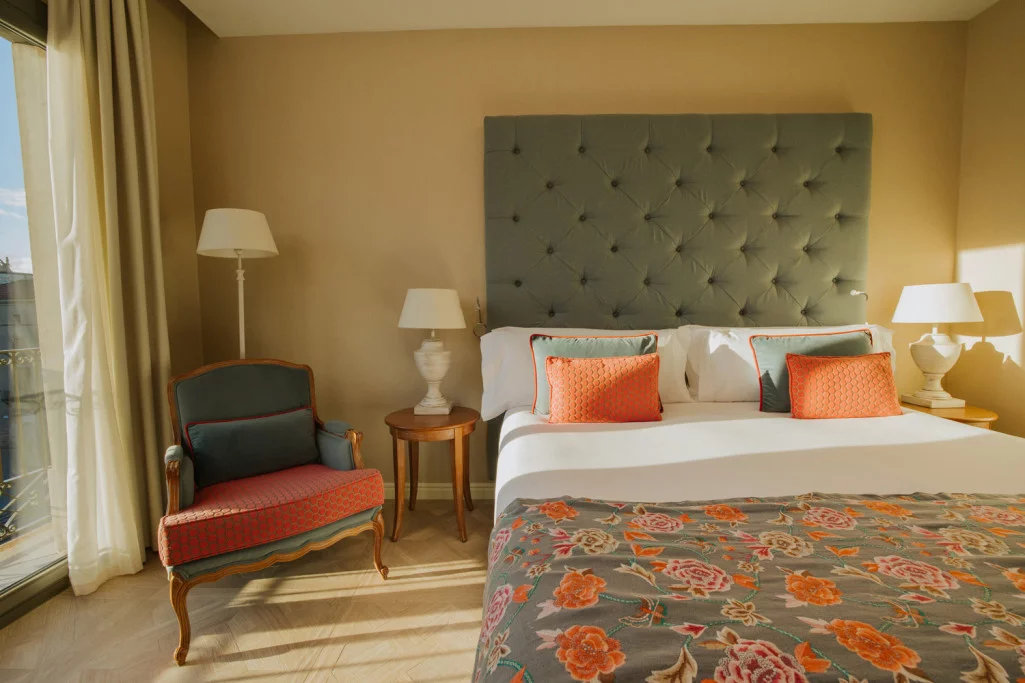
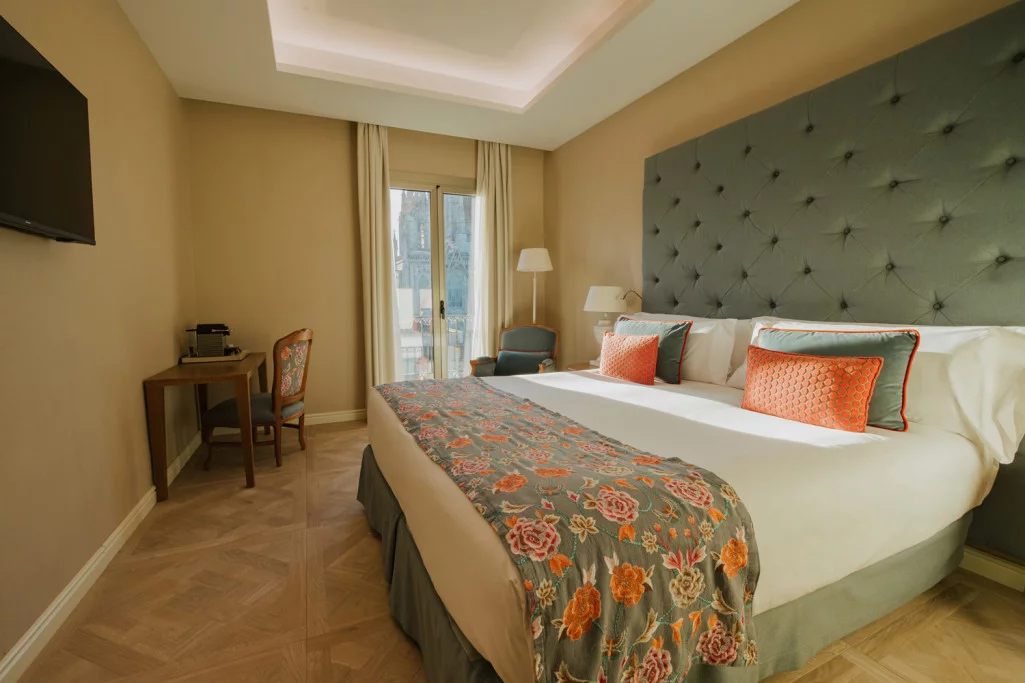
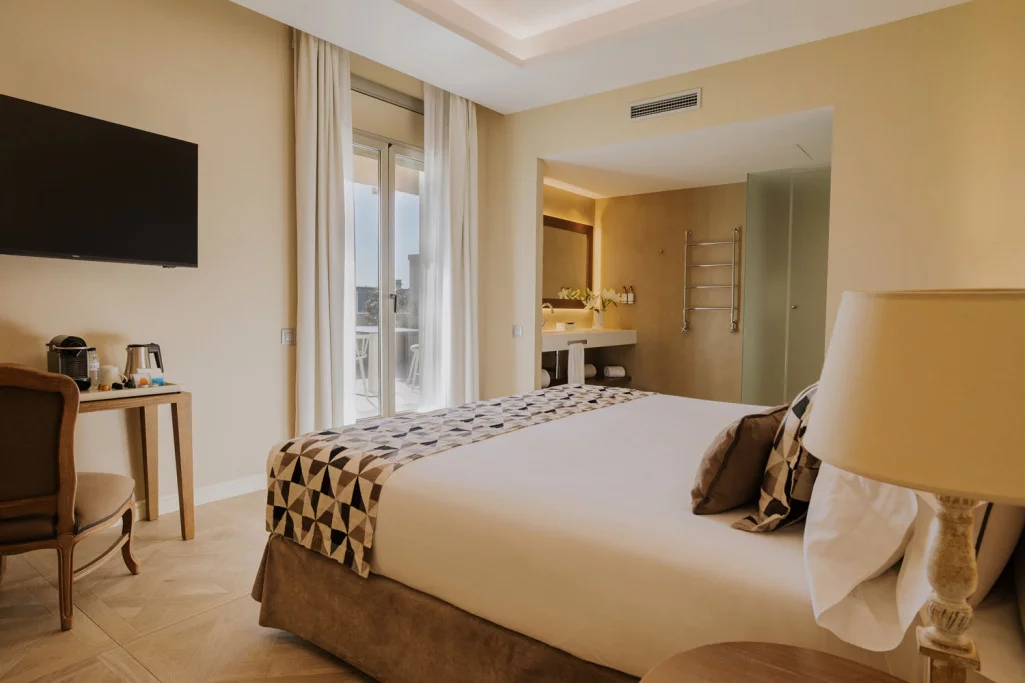
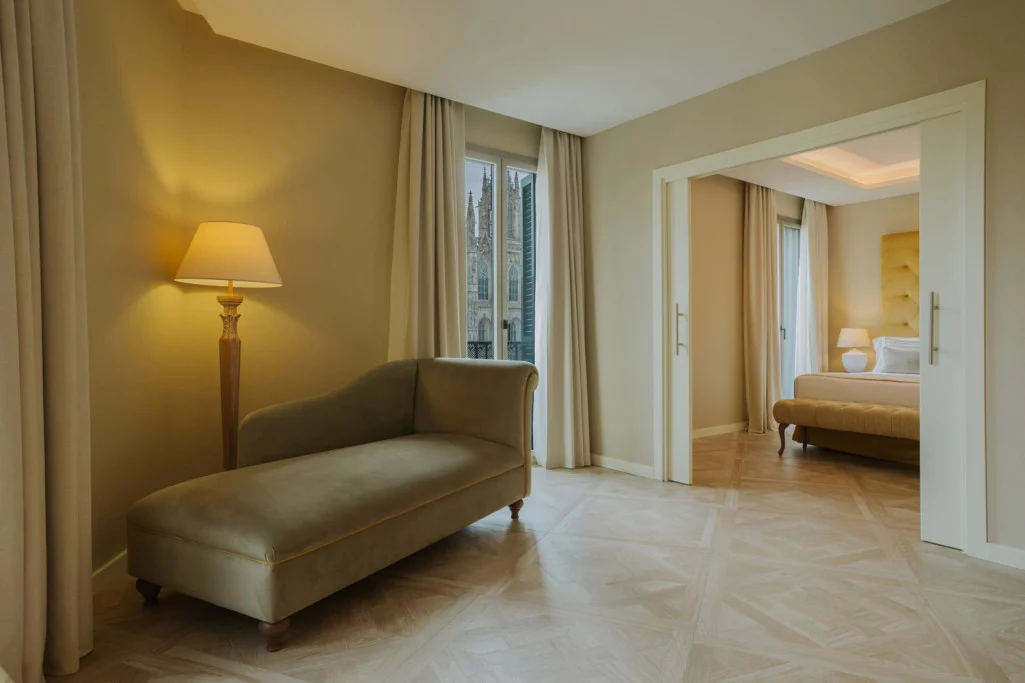
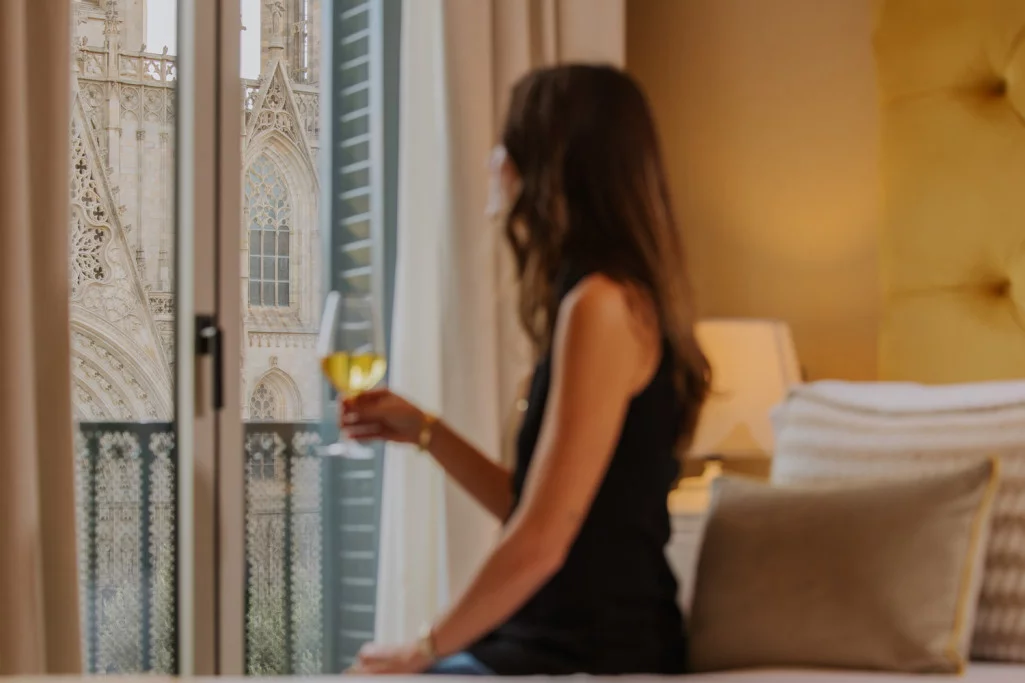
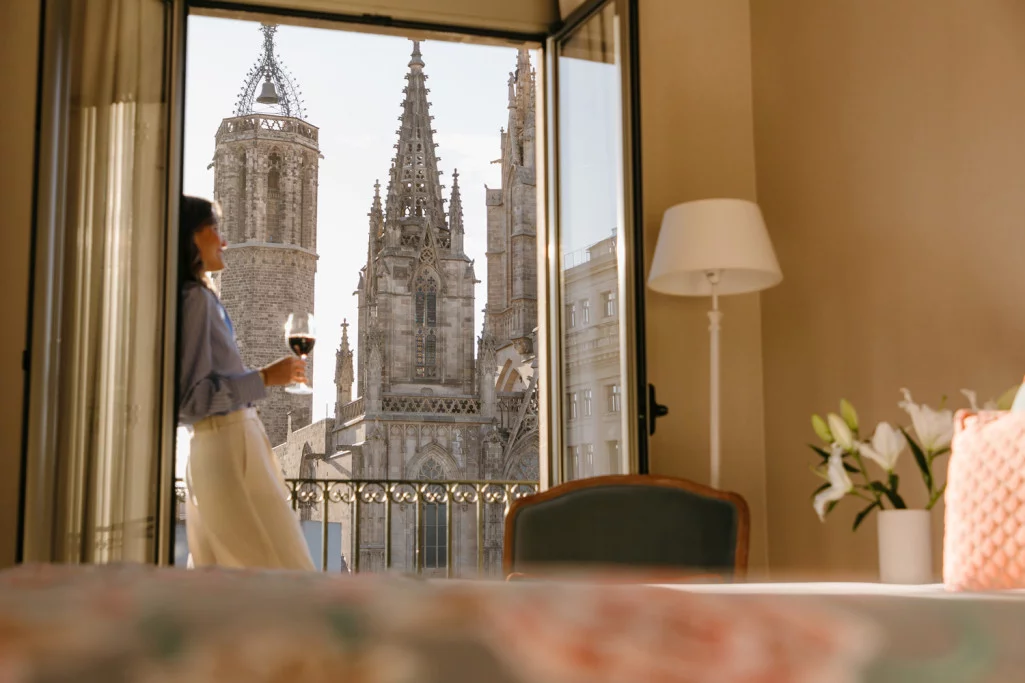
The Premium Suite combines design, comfort and privileged views of Barcelona Cathedral. With 25 m² for 1 or 2 guests, this suite invites you to enjoy an unforgettable experience from its private balcony, with views of one of the city's most iconic landmarks.
Design & Craft Tour included with direct bookings (through our website, by phone, or by email). A guided 2.5–3 hour tour of the artisan workshops in the Gothic Quarter, starting from the L'Àtic rooftop. There is only one tour per day, at 11:00 AM, subject to availability and prior confirmation. We recommend booking in advance by writing to concierge@lamarohotel.com, indicating your preferred date. More information
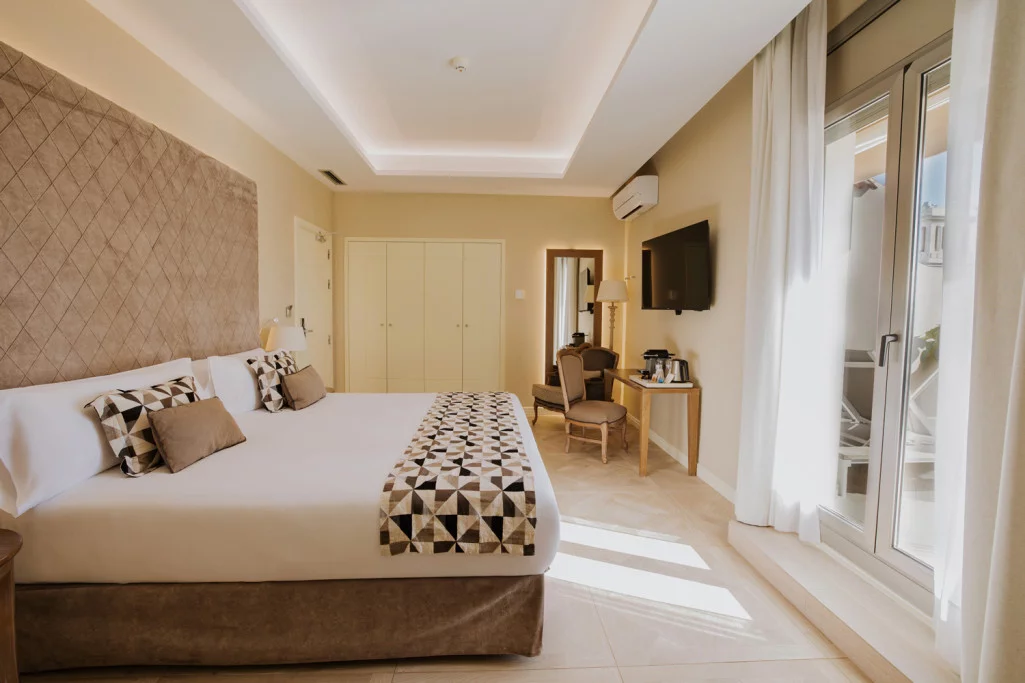
Skyline Suite
1 or 2 guests · terrace
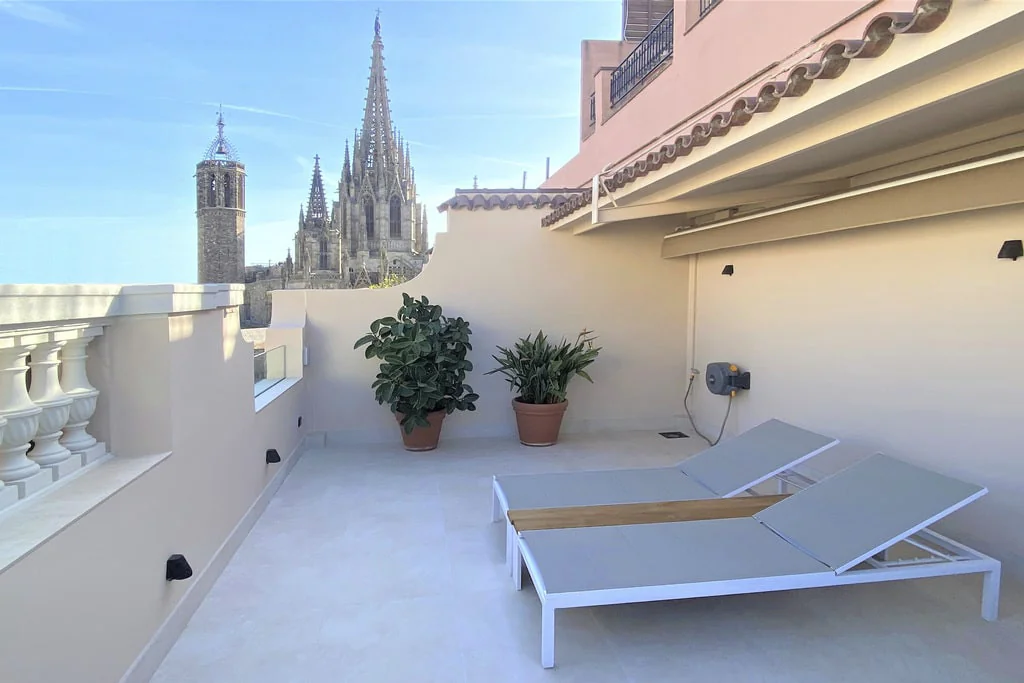
The Skyline Penthouse offers 20 m² of interior space and a spacious private terrace of 27 m², ideal for 1 or 2 guests looking to enjoy Barcelona from above. Located on the upper level of the hotel, this room combines a comfortable interior with an exclusive outdoor space, perfect for relaxing and taking in the city in a calm and privileged setting.
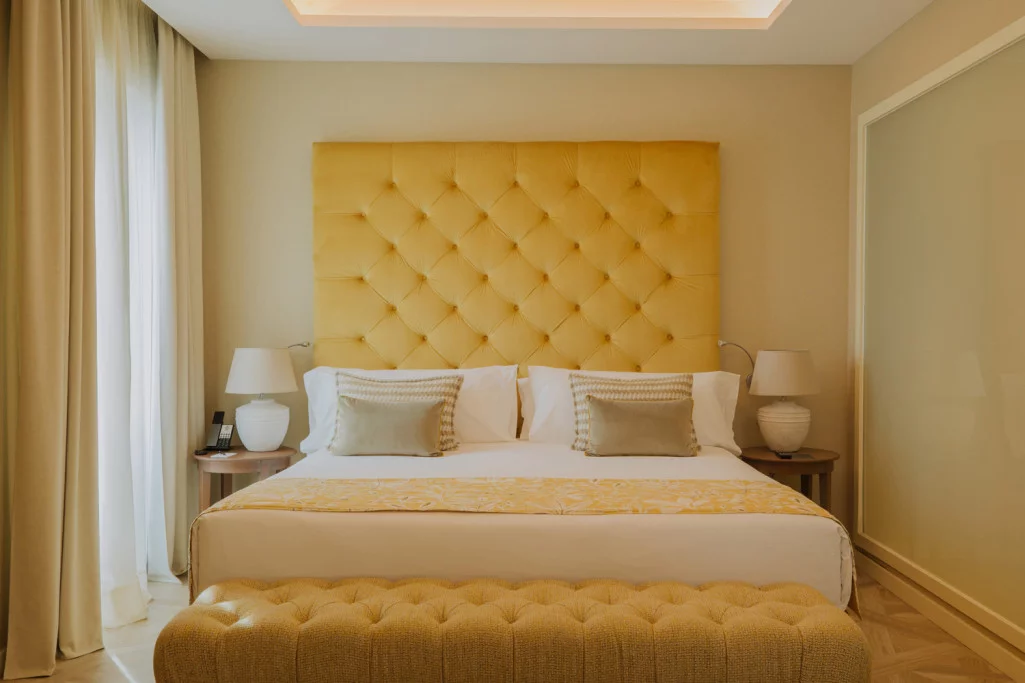
Grand Master Suite
4 guests · views · balcony
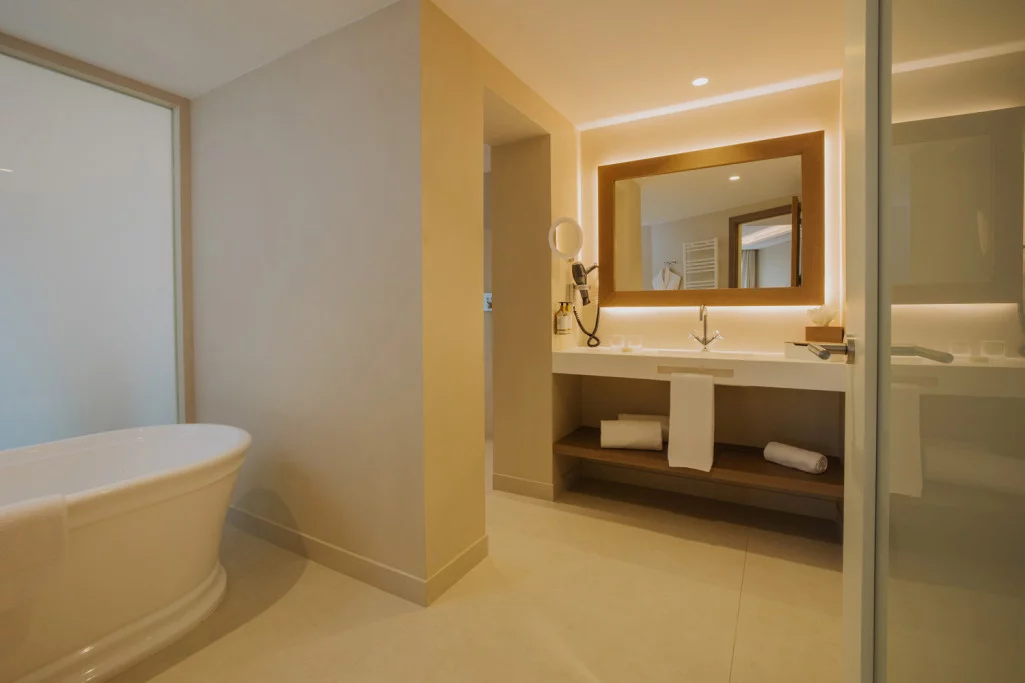
The Grand Master Suite is the most spacious and exclusive suite at Lamaro Hotel. With 72 m² of space, it is designed to comfortably accommodate up to 4 guests (2 adults and 2 children up to 17 years old), offering an elegant and functional setting for family stays or trips that require extra space. It features a King Size bed, a bathroom with both a shower and a bathtub, and two private balconies offering views of Barcelona Cathedral, bringing in natural light and a direct connection with the city's historic surroundings. A suite that combines space, comfort and a privileged location in the heart of Barcelona.
Design & Craft Tour included with direct bookings (through our website, by phone, or by email). A guided 2.5–3 hour tour of the artisan workshops in the Gothic Quarter, starting from the L'Àtic rooftop. There is only one tour per day, at 11:00 AM, subject to availability and prior confirmation. We recommend booking in advance by writing to concierge@lamarohotel.com, indicating your preferred date. More information